Digital Marketing Strategy
SEO vs Google Ads: What Should Businesses Choose?
When people need a product or service, one of the first things they usually do is search online. They might type "best salon near me," "digital marketing agency in Kaithal," "best furniture shop," or "dentist near me." For businesses, appearing in these searches can help them reach potential customers at the right moment.
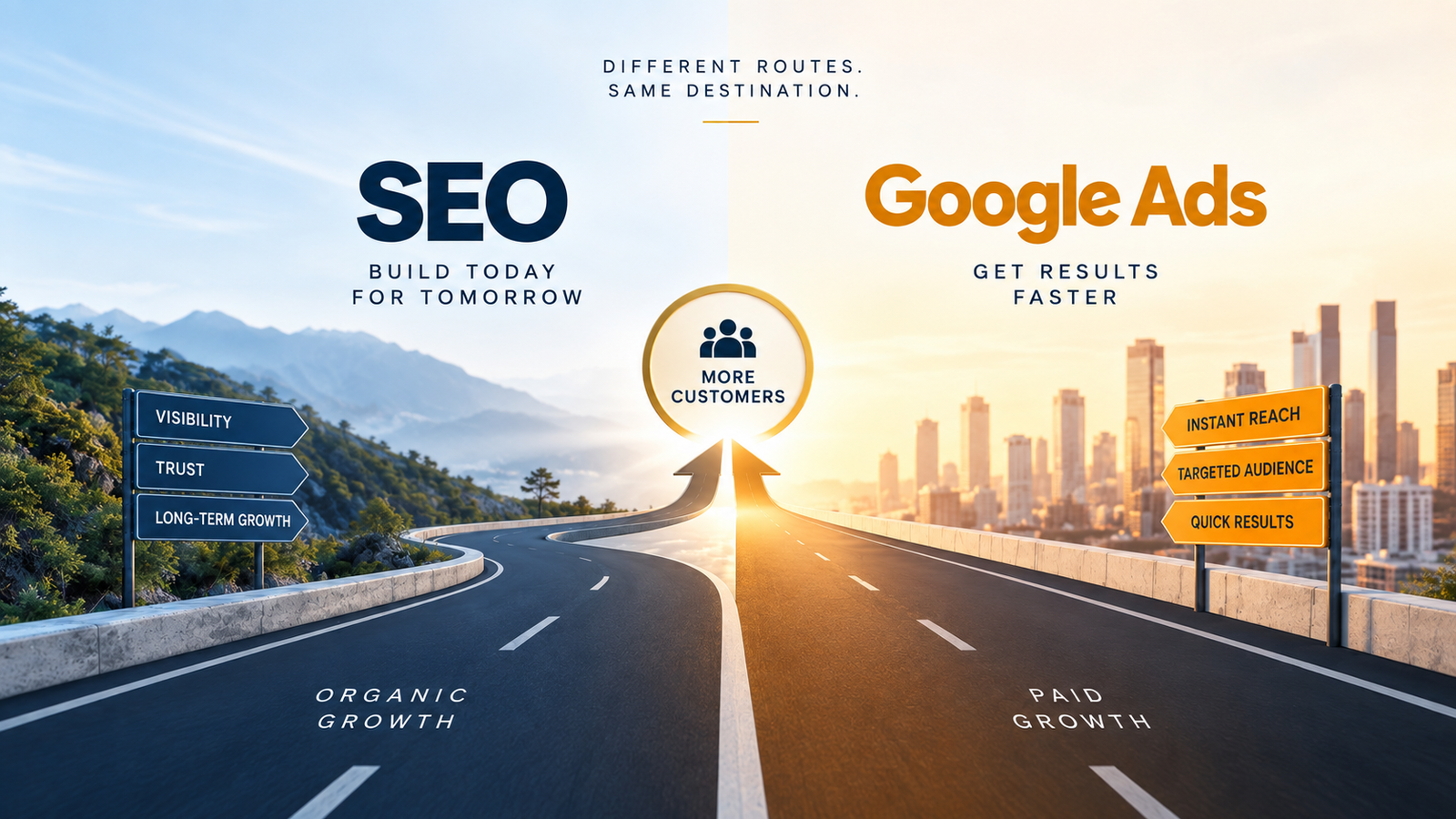
This is where SEO and Google Ads become important. Both can help businesses gain visibility on Google, but they work differently. SEO focuses on organic search, while Google Ads focuses on paid search advertising.
So, Which One Should a Business Choose?
The answer depends on your business goals, budget, competition, and how quickly you need results.
What Is SEO?
SEO (Search Engine Optimization) is the process of improving your website and online presence so your business has a better chance of appearing in Google's organic search results.
For example, imagine you run a bakery and someone searches:
"Best birthday cake shop near me."
If your website and Google Business Profile are properly optimized, your business may appear in the organic results.
SEO usually involves:
- Keyword research
- Website optimization
- Creating useful content
- Improving website speed
- Building quality backlinks
- Local SEO
- Google Business Profile optimization
- Improving user experience
The main goal is to make your website useful, relevant, trustworthy, and easy to understand for both customers and search engines.
The Biggest Advantage of SEO
One major advantage of SEO is that you don't pay Google for every organic click.
However, SEO isn't completely free. Businesses still need to invest in content, website improvements, SEO tools, technical work, optimization, and professional services when needed.
Most importantly, SEO is generally a long-term investment. You build your online presence gradually rather than paying for every individual visit.
What Are Google Ads?
Google Ads is Google's paid advertising platform.
With Google Ads, businesses can create advertisements that appear when people search for specific keywords related to their products or services.
For example, suppose you own a dental clinic and target:
"Dentist near me"
Your advertisement may appear when someone searches for that term.
Google Ads gives businesses control over:
- Keywords
- Location
- Budget
- Audience
- Ad message
- Landing page
- Campaign schedule
Depending on the campaign and bidding model, businesses generally pay when users interact with their advertisements.
The Biggest Advantage of Google Ads
Speed.
A properly set-up Google Ads campaign can start generating impressions and clicks much faster than a new SEO campaign.
This can be useful for businesses that:
- Have just launched
- Need leads quickly
- Are promoting a limited-time offer
- Are launching a new product
- Want to test a new service
However, speed doesn't automatically mean profitability. A poorly managed campaign can spend money without generating enough customers.
SEO vs Google Ads: The Main Difference
The simplest way to understand the difference is:
SEO = Earn Visibility
Google Ads = Pay for Visibility
With SEO, you work consistently to improve your organic rankings.
With Google Ads, you pay to display your advertisements to people searching for relevant keywords.
- Organic search — Paid search
- Takes time to build — Can start quickly
- No payment for every organic click — Usually involves payment for ad interactions
- Long-term strategy — Useful for immediate campaigns
- Requires ongoing optimization — Requires ongoing budget
- Builds organic visibility — Provides paid visibility
- Can continue generating organic traffic after rankings improve — Traffic generally depends on an active campaign
Neither option is automatically the right choice for every business.
When Should a Business Choose SEO?
SEO can be particularly useful for businesses that want to build long-term online visibility.
Imagine you run a local furniture business. You may want your website to appear when people search for:
- Furniture shop near me
- Sofa sets in [city]
- Best furniture store
- Bedroom furniture
- Custom furniture
Instead of relying only on paid advertisements, you can work on SEO to improve your organic visibility for relevant searches.
Over time, SEO can also help businesses build brand awareness and trust.
SEO Takes Time
A new website usually won't rank at the top for highly competitive keywords overnight.
Results can depend on factors such as:
- Competition
- Website quality
- Content
- Website authority
- Location
- Search demand
- Overall SEO strategy
That's why businesses should view SEO as a long-term strategy, rather than expecting instant results.
When Should a Business Choose Google Ads?
Google Ads can be useful when speed and immediate visibility are important.
For example, imagine a new salon has just opened in your city. The business wants potential customers to discover its services quickly. Instead of waiting for organic rankings to develop, it can use Google Ads to target relevant searches within its service area.
Google Ads Can Be Useful For:
- New product launches
- Seasonal offers
- Limited-time promotions
- Event registrations
- Lead generation
- High-intent local searches
- Testing new services
Another benefit is the ability to track campaign performance and make changes to your budget, keywords, advertisements, and targeting based on the data.
But Google Ads Is Not Automatically Profitable
Running Google Ads doesn't guarantee sales or leads.
If a campaign has:
- Poor keyword selection
- Weak advertisements
- Incorrect targeting
- A poor landing page
- Improper conversion tracking
- An unsuitable budget
the business may spend money without getting enough customers.
That's why successful Google Ads campaigns require planning, testing, tracking, and continuous optimization.
Which Is More Cost-Effective: SEO or Google Ads?
This is one of the most common questions businesses ask.
The answer isn't simply "SEO is cheaper" or "Google Ads is cheaper."
It depends on the business, industry, competition, goals, and strategy.
With Google Ads, there is a direct advertising cost. If you want to continue receiving paid traffic, you generally need to maintain your campaign budget.
SEO doesn't charge you for every organic click, but it still requires investment in content, optimization, tools, technical improvements, and professional services.
A business may invest in SEO for several months before seeing significant growth. Once important keywords begin ranking, however, they can potentially continue bringing organic traffic without paying for every individual click.
This is why businesses should focus on customer acquisition cost (CAC) and return on investment (ROI) instead of simply comparing the cost of a click.
Can Businesses Use SEO and Google Ads Together?
Absolutely.
SEO and Google Ads don't have to be competing strategies. They can work together.
Think of it this way:
Google Ads can help you get traffic now.
SEO can help you build organic visibility for the future.
For example, a local clinic could use Google Ads to generate enquiries for important services while simultaneously working on:
- SEO
- Service pages
- Local search optimization
- Helpful articles
- Google Business Profile optimization
Google Ads can also provide useful information about which keywords and messages generate clicks or conversions. Businesses can use this data to better understand what their customers are searching for.
At the same time, building organic visibility through SEO can help businesses reduce their dependence on paid advertising over time.
What Should Small Businesses Choose?
If you're a small business owner, start with three simple questions.
1. Do you need customers quickly?
If you need immediate visibility or leads, Google Ads may be worth considering because paid search can provide faster exposure.
2. Are you building an online presence for the long term?
If you're looking to build sustainable organic visibility, SEO should be part of your strategy.
3. Can you afford both?
If your budget allows, using SEO and Google Ads together can help you work toward both short-term and long-term goals.
If your budget is limited, focus on the strategy that best matches your current business objective rather than trying to do everything at once.
Don't Forget the Landing Page
Getting people to your website is only half the job.
Whether visitors come through SEO or Google Ads, your website needs to turn those visitors into enquiries, calls, bookings, or sales.
A Good Landing Page Should Have:
- A clear headline
- Simple navigation
- A strong call-to-action
- Relevant information
- Trust signals or customer reviews
- Mobile-friendly design
- Fast loading speed
- Easy contact options
Remember:
More traffic doesn't automatically mean more customers.
If your website isn't convincing or easy to use, increasing traffic may not solve the real problem.
Final Thoughts
SEO and Google Ads don't have to be competitors.
They are two different ways of getting your business in front of potential customers.
SEO focuses on organic search and long-term visibility, while Google Ads focuses on paid search and faster visibility.
If your goal is immediate traffic or leads, Google Ads can be useful.
If your goal is to build long-term organic visibility, SEO can play an important role.
For many businesses, the real question isn't simply:
"SEO or Google Ads?"
Instead, ask:
"How can we use SEO and paid search together to grow the business profitably?"
Your strategy should consider your industry, competition, location, budget, customer search behaviour, and business objectives.
Start with a clear goal, track your results, understand where your customers are coming from, and invest more in the channels that are actually contributing to your business growth.
Because the goal isn't just to get more clicks.
The goal is to turn visibility into real business results.
Ready to grow?
Ready to put this into action?
Book a strategy call and we'll help you apply it to your business.