Digital Marketing Strategy
Why Is Your Website Not Generating Enough Leads?
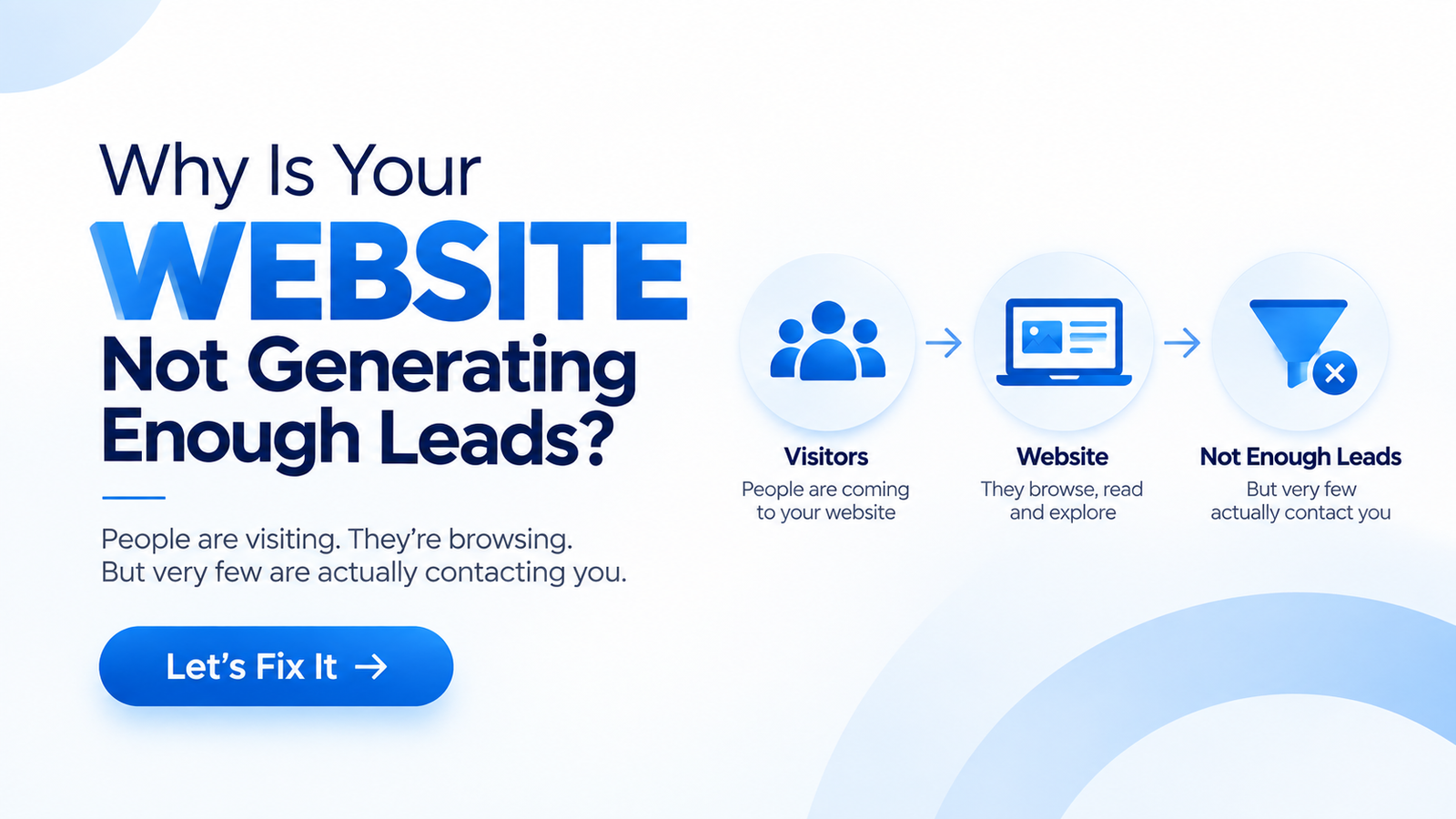
You have a website. People are visiting it. Your pages look professional, your services are clearly listed, and you may even be getting traffic from Google or social media.
But there is one problem: very few people are actually contacting you.
This is more common than you might think.
A website can get visitors without generating leads. Traffic is only the first step. The real challenge is turning those visitors into people who call, message, fill out a form, book an appointment, or request more information.
So, why does this happen?
Let's look at some of the most common reasons.
1. Your Website Talks About You, Not the Customer
One of the biggest mistakes businesses make is filling their website with statements like:
- We are a leading company.
- We provide high-quality services.
- We have years of experience.
- We offer the best solutions.
There is nothing wrong with these statements, but they don't immediately answer the customer's main question:
- How can you solve my problem?
For example, someone searching for a digital marketing service may not care initially about how long a company has existed. They want to know whether the service can help them generate leads, improve visibility, or attract customers.
A good lead generation website should focus on the customer's problems, needs, and desired outcomes.
2. Visitors Don't Know What to Do Next
Imagine visiting a website and finding plenty of information—but no clear next step.
You read the homepage, check the services, scroll through some images, and then leave.
This happens when a website doesn't have a clear Call to Action (CTA).
Your visitors should not have to figure out what to do next.
Depending on your business, the next step could be:
- Get a Free Quote
- Book a Consultation
- Call Now
- Request a Callback
- Schedule an Appointment
- Send an Enquiry
The CTA should be visible at the right places and should clearly communicate the action you want visitors to take.
3. Your Website Is Difficult to Use on Mobile
A large portion of internet users browse websites through smartphones.
If your website looks good on a laptop but becomes difficult to use on a phone, you may be losing potential customers without realizing it.
Small text, buttons that are difficult to tap, slow-loading images, excessive scrolling, or broken layouts can quickly frustrate visitors.
A good website for business needs to work smoothly across different screen sizes.
Before focusing on complicated design elements, check something simple:
- Can a person understand your offer and contact you easily from their phone?
If the answer is no, that should be fixed first.
4. Your Website Is Slow
People don't like waiting for a website to load.
Large images, unnecessary animations, poorly optimized files, and technical issues can slow down a website.
A visitor who waits several seconds for a page to load may simply close the tab and look somewhere else.
Website speed isn't just a technical issue. It can affect the overall user experience and, indirectly, your website conversion rate.
A simple, fast website can often be more useful than a visually impressive website that takes too long to load.
5. Your Offer Isn't Clear
Sometimes the problem isn't the design. It's the message.
A visitor should be able to understand within a few seconds:
- What do you offer?
- Who is it for?
- Why should they consider it?
- What should they do next?
If your homepage uses vague headlines such as "Transforming Your Future" or "Solutions Beyond Expectations," visitors may not understand what the business actually does.
Clear communication usually works better.
Instead of trying to sound impressive, try to sound understandable.
6. There Isn't Enough Trust
People hesitate before sharing their contact information, especially when they are dealing with a business for the first time.
Your website should give visitors reasons to feel comfortable taking the next step.
Useful trust-building elements can include:
- Customer reviews
- Testimonials
- Case studies
- Relevant certifications
- Portfolio examples
- Frequently asked questions
- Clear contact information
- Transparent service details
You don't need to put everything on one page. The goal is simply to reduce uncertainty.
A visitor should feel that they understand who they are dealing with and what happens after they make an enquiry.
7. You're Getting the Wrong Traffic
More visitors don't automatically mean more leads.
Suppose your website gets 10,000 visitors, but most of them are looking for information unrelated to your actual service. Those visitors may not become customers.
This is why website lead generation also depends on attracting the right audience.
Your SEO content, advertisements, social media posts, and landing pages should ideally target people who have a genuine interest in what you offer.
The quality and relevance of traffic matter just as much as the number of visitors.
8. Your Contact Form Is Asking Too Many Questions
A long form can discourage people from completing it.
If someone only wants a quote but your form asks for their name, email, phone number, company size, address, budget, industry, business revenue, and several other details, they may simply leave.
Ask only for the information you actually need at the first stage.
You can always collect additional information later.
9. You're Not Measuring What Happens
This is perhaps the most overlooked part.
If you don't know how visitors behave on your website, it becomes difficult to understand why you're not getting leads.
Track things such as:
- Number of visitors
- Traffic sources
- Most visited pages
- Form submissions
- Phone clicks
- CTA clicks
- Landing-page performance
- Pages where visitors leave
These numbers can reveal problems that aren't obvious from simply looking at the website.
The Bigger Picture
A website isn't just an online brochure.
When designed properly, it can help educate visitors, answer questions, build trust, and make it easier for interested people to take action.
But website conversion doesn't happen because a website simply "looks good."
It happens when several things work together:
- Right audience → Clear message → Useful information → Trust → Easy action
If one of these steps is missing, visitors may leave without becoming leads.
So before redesigning your entire website, look at the basics first.
Ask yourself:
- Is my message clear?
- Can visitors quickly understand my offer?
- Is the website easy to use on mobile?
- Is there a clear CTA?
- Does the website build trust?
- Am I attracting the right visitors?
- Am I actually measuring conversions?
Sometimes, the problem isn't that your website needs more visitors.
It may simply need to do a better job with the visitors it already has.

Ready to grow?
Ready to put this into action?
Book a strategy call and we'll help you apply it to your business.